Move It Inward

Make decision authority visible and move recurring decisions closer to the people with the most relevant information—without giving up alignment, accountability, or appropriate risk control.
How to Use It
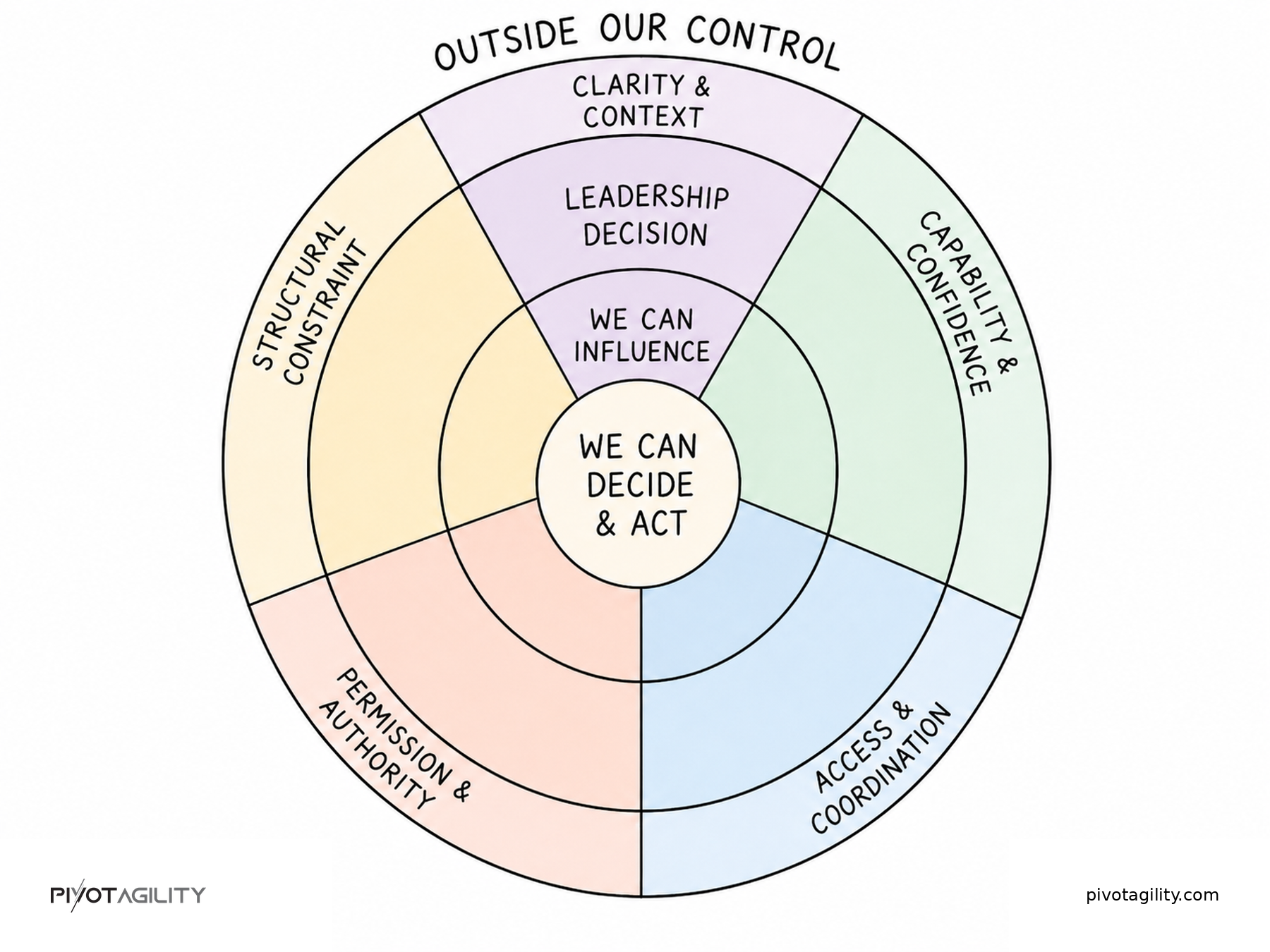
Map recurring decisions where authority actually sits today using four zones: We Can Decide & Act; We Can Influence; Leadership Decision; Outside Our Control. Mark the main reason a decision remains there using one of five barrier lenses: Clarity & Context; Capability & Confidence; Access & Coordination; Permission & Authority; Structural Constraint. Select one recurring decision that may be able to move one zone inward. Define what must become true—information, capability, guardrails, thresholds, consultation, accountability, and escalation triggers—then design a small safe test. Move the decision inward only when the new location is credible and responsible.
Questions to Explore
Where is this decision actually made today?
Why does it sit there?
Which barrier is doing the most to keep it there?
Could this decision responsibly move one zone inward?
What would have to become true for that move to work?
What guardrails or thresholds would make the move safe?
When should the team consult or escalate?
What small test can we run before making the change permanent?
Variations
Use prepared recurring-decision cards for a compressed version. For deeper operational work, build the target from a real decision inventory and revisit it after the experiment to see whether the decision should stay, move farther inward, or return outward. The barrier lenses may be captured with notes rather than baked into the target when a simpler visual is preferred.
Using It Responsibly
Use the target to find the closest responsible decision location, not to push every decision toward the center. Some decisions appropriately remain with leadership or outside the team. Preserve explicit guardrails, accountability, and escalation triggers when authority moves inward.
Source & Attribution
Original PivotAgility activity developed by Roy Schilling. Uses the Authority Target visual and a two-pass current-state / move-one-decision-inward method. The goal is the closest responsible decision location, not maximum delegation.
Comments