Value–Urgency Horizon Map

Make better sequencing decisions by considering value and urgency together. Explore the cost of doing nothing, determine what belongs in Now, Next, or Later, and then consider relative effort.

How to Use It
Start with a set of candidate work items and position them on the map using two dimensions: Value (vertical axis) and Urgency (horizontal axis). Consider the value each item could create and explore urgency through a practical question: What's the cost of doing nothing? What gets worse, remains exposed, or stays blocked if we wait?
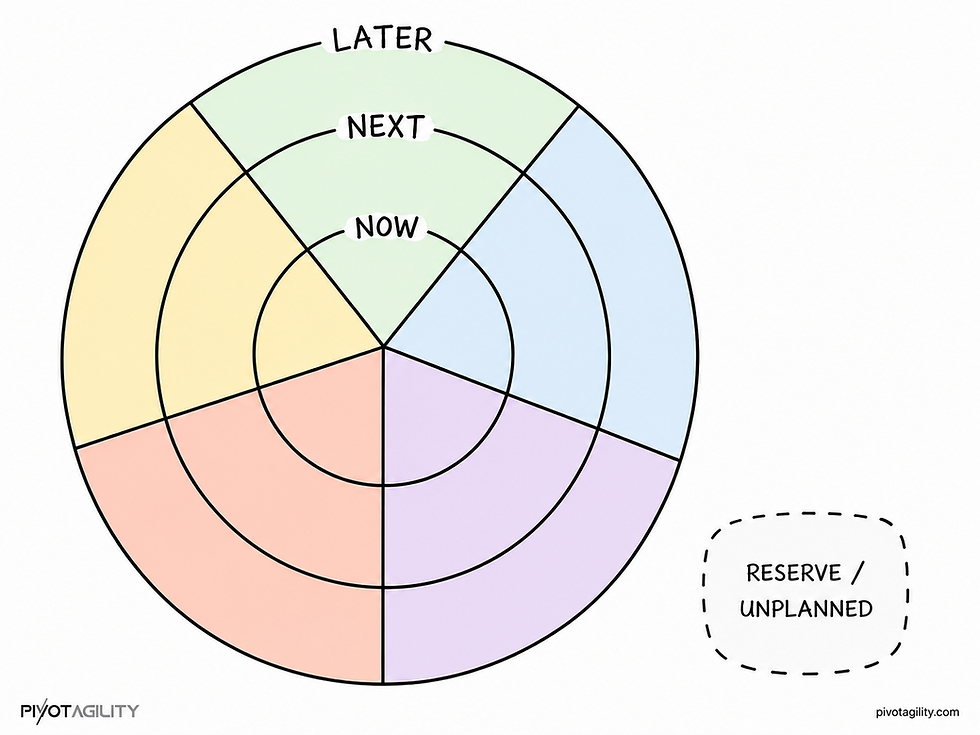
Place each item within the curved Now, Next, or Later regions. The deliberately small Now region makes finite capacity visible and forces meaningful trade-offs. Use the XXS–XL color legend to indicate relative size, but don't use size to determine placement. Once the work is positioned, examine what belongs in Now, whether it can realistically fit, and what might need to be sliced, deferred, or displaced. Capture the resulting decisions and revisit them as conditions change.
Questions to Explore
What value would this work create, and for whom?
What's the cost of doing nothing?
What gets worse, remains exposed, or stays blocked if we wait?
Does this work genuinely belong in Now, Next, or Later?
Are we trying to fit more into Now than our capacity allows?
Could a large item be sliced smaller while preserving its value or addressing its urgency?
What would we need to defer or displace to take this on?
What new evidence or changing conditions would cause us to reconsider its placement?
Variations
Use prepared work-item cards for a compressed prioritization exercise. For real operational planning, map an actual backlog, portfolio, or collection of investment opportunities. The map works on a physical wall or shared digital whiteboard. Revisit it during intake, roadmap reviews, or capacity discussions to explore whether changing conditions justify moving work between horizons.
Using It Responsibly
Use the map to support informed prioritization judgments, not to manufacture a precise ranking or delivery commitment. Value and Urgency are the only placement dimensions. Risk reduction, opportunity enablement, deadlines, and other considerations inform those judgments rather than becoming additional scoring factors. The curved boundaries allow trade-offs between Value and Urgency, while the small Now region makes capacity constraints explicit.
Relative size matters when deciding how to act on an item, not where it belongs. An item that is valuable and urgent doesn't automatically justify starting more work. Sometimes the responsible decision is to make it smaller, defer something else, or acknowledge that capacity is insufficient.
Source & Attribution
Original PivotAgility facilitation practice developed and used by Roy Schilling. Inspired by the Eisenhower Matrix, the Value–Urgency Horizon Map extends the concept through curved Now / Next / Later decision horizons, a deliberately constrained Now region, and an XXS–XL relative-size legend. The purpose is to improve prioritization judgment and make capacity trade-offs visible without introducing unnecessary scoring complexity.

Comments